..................................................................................................................................
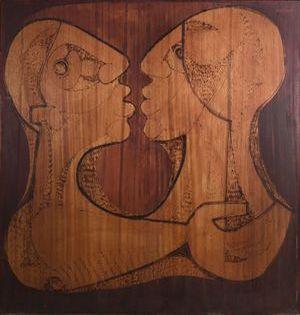
The
kiss
Pyrography
on board. 101 x 102 cms. Signed and dated on the back of the board.
1965
Private
collection
«What
is in those woord boards that are now Párragas? Firstly they
were lines, then fire. Now, they are bodies, hands, doves, fish, fruits,
roosters, leaves, spikes, eyes... to become wood again, and roots,
logs, earth, shadow.» (La
Verdad, 22-II-90)
Pyrography
was undoubtedly one of Párraga’s signature techniques.
He made a lot of pieces in all sizes, and they can be found in hundreds
of different locations. «...it isq
quite a reduced technique (...) it is hard. But that’s the fun
part for me. I like to take that hardness and turn it into reality».
(1)
«...
In 1963 he begins to practice pyrography, partially as a getaway from
the tirana of the color (...) he feels that the burnt wood can replace
the mural if he eliminates the concept of «painting»
(2)
He often used agglomerated boards as a base, covered in natural wood
laminates. This was a cheap and easy-to-find alternative for normal
sizes, and they can be easily connected to enlarge the working area.
The burnt
line creates a groove, which could be very profound. Párraga
fills his characteristic geometric figures with different intensities
and proximity of the lines.
To make
the figure stand out he darkens the background with anilines or Chinese
ink, both very diluted to avoid hiding the grain of the wood. He sometimes
painted some areas with acrylic or oil paints. (See)
This work
is one of the oldest ones documented up to this date. Maybe this is
the reason behind the hesitation of some lines, which he improved
notably in little time. He even stated in the press that Párraga
was considered -according to an alleged «ranking» of the
Unesco- as one of the best pyrography artists of the world.
«His
girlfriend, Chiqui, was a skilled collaborator. She was in charge
of burning the wood following the previous pencil traces that José
María had made». (La
Verdad, 13-VI-1964)
(1)
Antonio Segado del Olmo. 7 pintores con Murcia al fondo.
Sala Ed. Madrid 1977. Pág. 126
(2) Pedro Alberto
Cruz. Párraga, Exposición antológica.
1998. Pág. 94-95